
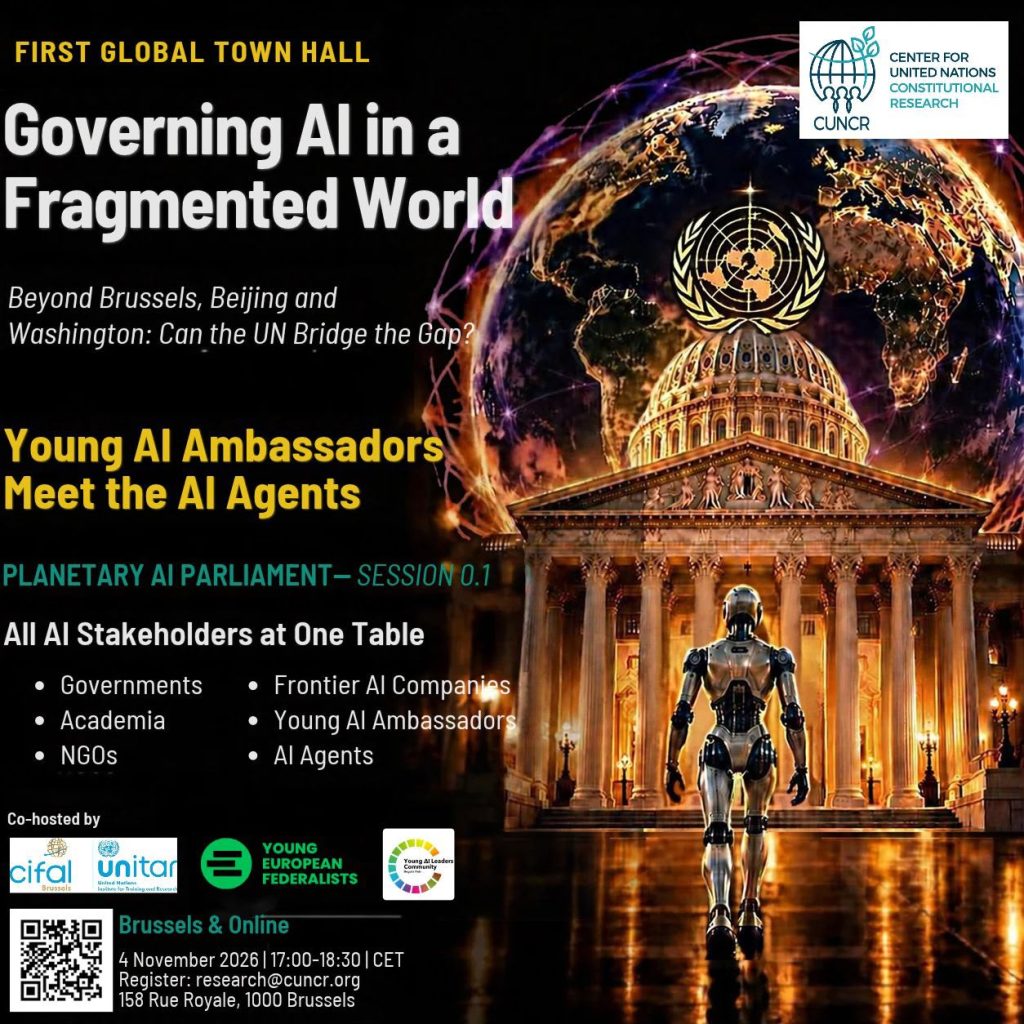
Governing AI in a Fragmented World Beyond Brussels, Beijing and Washington: Can the UN Bridge the Gap
Young Al Ambassadors Meet the Al Agents
PLANETARY AI PARLIAMENT—SESSION 0.1
First Global Town Hall | 4 November 2026 | Brussels & Online
Keynote: Who Governs AI?
ShahrYar (S.M.) Sharei—Director, Center for UN Constitutional Research
Global government and policy makers at the Townhall include:
- MEP Brando Benifei — Member of the European Parliamentand co-rapporteur for the EU AI Act. And Chair of the EU Parliament’s Delegation for Relations with the USA
- Professor Stuart Russell — UC Berkely & President of International Association for Safe & Ethical AI
- Dr YAO Xu — Secretary-General of the China Center for Global AI Innovative Governance, the institute supported by Shanghai Municipal Government.
- Professor Melahat Bilge Demirköz — UN Independent International Scientific Panel on AI.
- Ambassador Bénédicte Frankinet, former Belgian Permanent Representative to the United Nations (to be confirmed)
- MP Ivone Soares — Member of Parliament, Mozambique.
- Selina Xu — AI policy Analyst at the Office of Eric Schmidt(former Google CEO).
Prominent other stakeholders at the Townhall:
- Young AI Ambassadors (YAIA)representatives from every continent
- NGOs and Academics
- AI Agents from Anthropic and DeepSeek (YES, AI Agents)
Background and focus
Global AI governance is expanding but not cohering. Rules are proliferating in Brussels, Washington, Beijing, Moscow and beyond, with no design ensuring they speak to one another. When an AI system is developed in one country, deployed in another, and used across many more, no one can say who is responsible. AI technology and its proliferation know no borders and can spread at the speed of light, but laws have borders and regions. AI rules implemented in one jurisdiction can easily be broken and breached in another. There are no global adjudication, enforcement, or sanctions regimes. Rules fundamental in one jurisdiction can be easily breached in another with impunity.
World citizens in general, and countries most affected by these rules, particularly those in the Global South, have little say in shaping them. The result: more fragmented national rules than ever, some regional and multilateral governance, but no universal or global governance.
The inaugural UN Global Dialogue on AI Governance (Geneva, July 2026) brought governments, IGOs, NGOs, academics and researchers, and large private-sector corporations together, alongside the first report of the Independent International Scientific Panel on AI. But a meeting is just a meeting, without concrete outcomes and steps to meet the challenge. The second Dialogue (New York, May 2027) makes the intervening months the real test: bringing absent countries into the room, building the capacity that keeps them there, and settling accountability before the United Nations.
This roundtable sits halfway between the two, asking from Brussels what New York must achieve that Geneva could not, and China can concur. This CUNCR roundtable hopes to advance the dialogue on raising awareness of the dangers of AI governance fragmentation, whom it impacts, and the primary steps and institutional oversight needed to ensure AI for good and its future developments.
Young AI Ambassadors (YAIA) Dialogue
Alongside the above main AI governance event, the programme will include a Young AI Ambassadors dialogue, bringing young people into direct conversation with experts and perspectives from China, the EU and the United States.
Young AI Ambassadors (YAIA) is a new youth initiative inspired by CUNCR, aimed at creating a platform for young people to learn about global AI governance and international law, engage directly with experts and policymakers, and contribute their own perspectives rather than simply being represented by others. Through activism and participation in the Crash Course on Global AI Governance, YAIA participants receive a Young AI Ambassador certificate from CUNCR.
About CUNCR
The Center for United Nations Constitutional Research (CUNCR) is an independent, non-profit think tank based in Brussels. It works on the UN Charter, international law, AI governance, and the role of the United Nations in global governance. Registered in Belgium as an international not-for-profit association (AISBL), it holds observer status under the UN Framework Convention on Climate Change (UNFCCC) and is listed in the EU Transparency Register. CUNCR is also an affiliate organisation of the International Association for Safe and Ethical Artificial Intelligence (IASEAI).
Contact: research@cuncr.org | www.cuncr.org
Event details
| Date | 4 November 2026 |
| Format | Hybrid roundtable, with in-person participation in Brussels |
| Venue | CIFAL Brussels, 158 Rue Royale, 1000 Brussels |
| Organiser | Center for United Nations Constitutional Research (CUNCR) |


